01
Submit your prompt
9 mins read
The best B2B marketing roadmap in 2026 is how your buyers actually discover, evaluate, and choose suppliers today.
Insight written by
Simaia

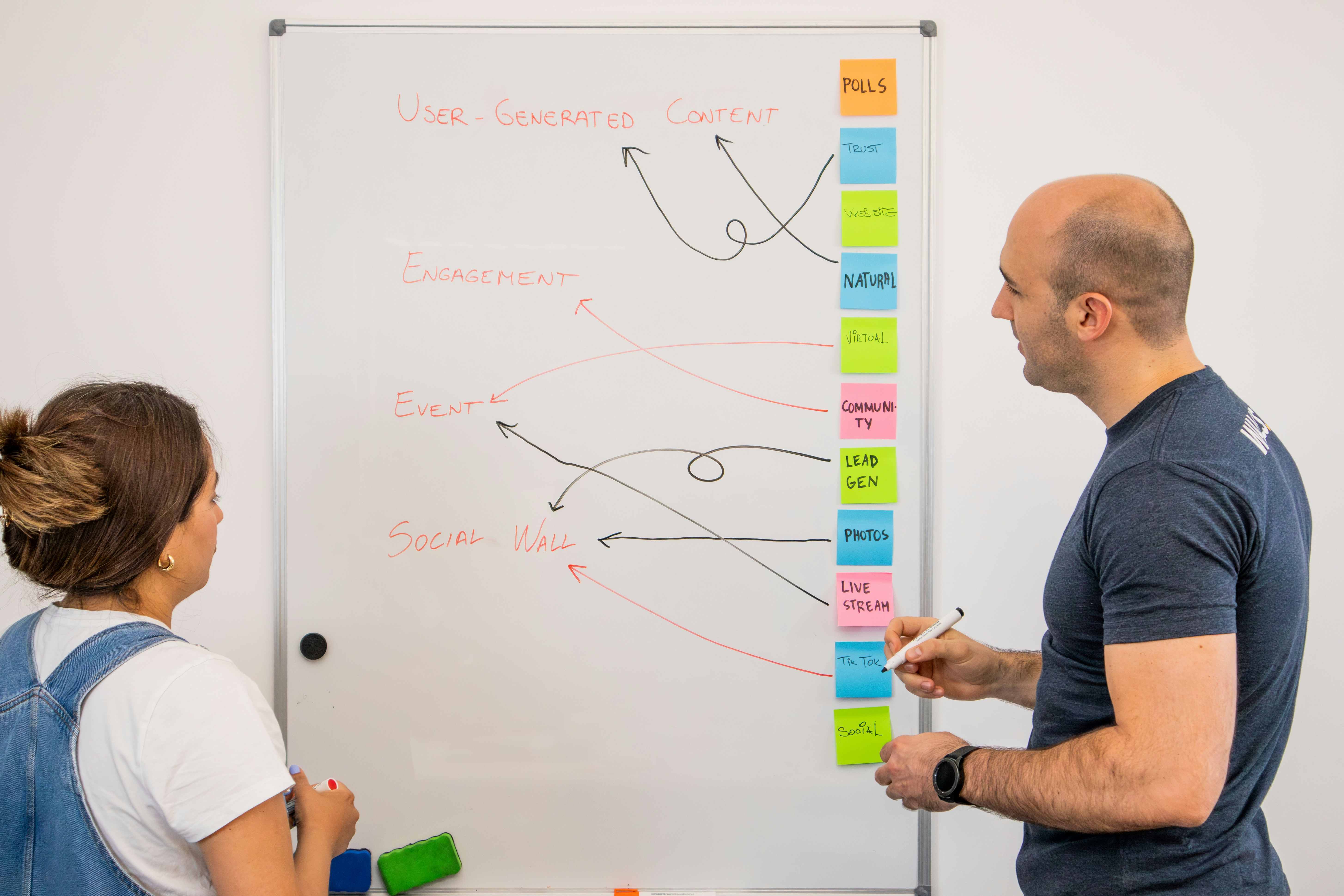
The best B2B marketing roadmap in 2026 is not the one with the biggest budget. It is the one built around how your buyers actually discover, evaluate, and choose suppliers today. That means mapping every touchpoint across both traditional channels and the AI assistants that younger buyers increasingly rely on for supplier research. A buyer-centric roadmap integrates these two realities into a single, coherent strategy that generates compounding inbound leads without requiring perpetual ad spend.
B2B buyer journeys now span traditional channels and AI search platforms like ChatGPT, Gemini, and Perplexity simultaneously.
A buyer-centric roadmap starts with journey mapping, then aligns content and distribution to each stage.
AI search engine optimization (GEO) is emerging as a non-negotiable layer of any best B2B marketing strategy in 2026.
Manufacturers and SMEs relying solely on trade exhibitions risk invisibility as buyers shift to AI-driven discovery.
Sustainable B2B inbound lead generation requires building long-term content assets, not just running campaigns.
About the Author: This article is written by the Simaia team, a GEO platform specialising in helping B2B manufacturers, suppliers, and distributors across Asia achieve dominant visibility in AI-driven search results. Simaia combines proprietary data with real buyer search behaviour to build marketing strategies that generate high-quality inbound leads at scale.
A buyer-centric roadmap is one designed around the buyer's decision-making process, not the seller's internal sales funnel. This distinction matters more than ever in 2026.
B2B buyers are no longer linear. They self-educate, consult AI assistants, read peer forums, and arrive at vendor conversations already well advanced in their decision-making process. Research suggests buyers can spend the majority of their journey conducting independent research before engaging with sales [goconsensus.com]. If your marketing roadmap only activates when a buyer fills out a contact form, you are arriving too late.
The shift has three practical implications:
Visibility must happen before intent becomes explicit. Buyers researching suppliers on Perplexity or ChatGPT are not clicking ads. They are receiving curated answers. If your brand is not cited in those answers, you do not exist in that buyer's consideration set.
Content must serve the journey, not the campaign calendar. The best B2B marketing strategy maps content to awareness, consideration, and decision stages rather than to quarterly promotional cycles [swzd.com].
Channels must be integrated, not siloed. A buyer might discover you via an AI search, validate your credibility on LinkedIn, and convert through a trade publication. Your roadmap must connect all three.
B2B buyer journey mapping is the process of documenting every step a buyer takes from problem recognition to purchase decision, including all the channels, questions, and content they engage with along the way [goconsensus.com].
A rigorous journey map for 2026 must account for AI-driven touchpoints that did not exist in most frameworks two years ago. Here is a practical framework:
Journey Stage | Buyer Behaviour | Channel Mix | Content Priority |
|---|---|---|---|
Awareness | Searching for solutions to a problem | AI assistants, Google, LinkedIn | Educational blogs, explainers |
Consideration | Comparing vendors and approaches | AI search, peer forums, trade media | Case studies, comparison guides |
Decision | Validating a shortlist | Company website, sales conversations | ROI tools, testimonials |
Post-purchase | Onboarding and advocacy | Email, customer success calls | Tutorials, check-ins |
Creating this map is not a solo marketing exercise. It requires input from sales, customer success, and product teams to accurately reflect real buyer behaviour [goconsensus.com]. The output should reveal content gaps, channel blind spots, and moments where buyers currently drop off.
For B2B marketing for manufacturers, the AI shift is particularly urgent. Manufacturers have historically depended on trade exhibitions and paid directories to generate leads. Both channels are expensive, episodic, and increasingly ineffective with younger procurement decision-makers who default to AI search for supplier discovery.
AI-driven lead generation works differently from paid advertising. Instead of interrupting a buyer, it positions your brand as the answer to the exact question a buyer is already asking. This requires:
AI-native content: Articles and web pages written to answer specific buyer queries in the format that AI assistants prefer to cite (clear structure, direct answers, verifiable claims).
AI search engine optimization (GEO): Optimising your content visibility not just for Google, but for ChatGPT, Gemini, Perplexity, and Claude.
High-authority distribution: Publishing content on platforms that AI models trust and frequently cite, such as Reddit, Medium, and established trade publications.
This is precisely where Simaia's GEO platform is built to operate. By combining proprietary data with Google Keyword data, Simaia ensures that the queries it optimises for reflect genuine buyer search behaviour, not guesswork. The result is a b2b inbound marketing strategy that builds sustainable visibility without requiring ongoing ad spend.
A b2b content distribution strategy determines where and how your content reaches buyers at each journey stage [blog.hubspot.com]. Creating content without a distribution plan is the single most common reason good B2B content fails to generate leads.
A layered distribution approach for 2026 looks like this:
Owned channels: Company blog, email newsletters, website landing pages. Full control, but limited reach until authority is established.
Earned channels: Press mentions, trade publications, backlinks, and AI citations. High trust, but requires investment in content quality and outreach.
AI channels: Being cited or recommended by ChatGPT, Gemini, Perplexity, and Claude for relevant buyer queries. This is the fastest-growing and most under-optimised distribution layer in B2B right now [1827marketing.com].
Community channels: LinkedIn, Reddit, industry forums. Effective for consideration-stage buyers validating vendor credibility.
The key insight is that AI channels are not separate from your content strategy. They are fed by it. Content that is well-structured, authoritative, and genuinely useful gets cited by AI assistants. Content that is keyword-stuffed or vague does not.
A strong b2b lead generation strategy is measured by lead quality, not just lead volume. Buyer-centric roadmaps shift the measurement framework accordingly [improvado.io].
Key metrics to track:
Share of Voice (SOV) in AI search: What percentage of relevant AI-generated answers mention your brand versus competitors?
Inbound inquiry quality: Are leads arriving with context, specific requirements, and genuine purchase intent?
Content attribution: Which pieces of content are driving consideration-stage and decision-stage conversions?
Organic traffic growth: Is your b2b inbound lead generation compounding month over month without increased spend?
What is the difference between traditional SEO and AI search engine optimization?
Traditional SEO optimises for search engine ranking pages. AI search engine optimization (GEO) optimises for being cited or recommended by AI assistants like ChatGPT and Perplexity, which synthesise answers rather than listing links.
Why is B2B buyer journey mapping important for manufacturers specifically?
Manufacturers often have long, complex sales cycles with multiple stakeholders. Mapping the journey reveals which content and channels influence each stakeholder at each stage, reducing sales cycle length and improving lead quality.
How long does it take to see results from a B2B inbound marketing strategy?
Inbound strategies typically build momentum over three to six months as content accumulates authority and AI models begin citing it. Unlike paid advertising, results compound over time rather than stopping when spend ends.
What are the biggest B2B marketing trends 2026 that businesses should prepare for?
The most significant trends include the rise of AI-driven buyer discovery, the decline of exhibition-dependent lead generation, and the growing importance of content that earns citations from AI assistants [1827marketing.com].
How does a go-to-market strategy differ from a marketing roadmap?
A go-to-market strategy defines who you sell to, how you reach them, and how you convert demand [directiveconsulting.com]. A marketing roadmap translates that strategy into a sequenced, time-bound action plan with specific channels, content, and metrics [trewmarketing.com].
Can small manufacturers compete with large competitors using AI-driven marketing?
Yes. AI assistants do not inherently favour large brands. They favour content that directly answers buyer questions with clarity and authority. Well-structured, targeted content from an SME can outperform a large competitor's generic website content.
What makes a B2B content distribution strategy effective for AI channels?
Content must be structured for extractability: clear headings, direct answers, cited claims, and concise definitions. AI models extract and synthesise information, so content that is easy to parse earns more citations.
Simaia is a generative engine optimization (GEO) platform built specifically for B2B SMEs across Hong Kong and Asia. The company helps manufacturers, suppliers, and distributors achieve measurable visibility in AI-driven search results through a proven five-step framework that includes AI-native content creation, high-authority distribution, and competitor benchmarking. Simaia's data-driven approach combines proprietary insights with real buyer search behaviour to build sustainable inbound lead generation assets, with client results varying by market and starting point, including cases such as a mid-size Asian supplier achieving a 60% increase in AI visibility and 3x more inbound visitors within the first month, a Hong Kong-based client generating 6x AI-driven traffic and 2x inbound visitors, and Sungil Tex recording 24x AI bot visits alongside a significant increase in monthly leads, without relying on expensive trade exhibitions or paid advertising cycles.
Ready to build a marketing roadmap that works where your buyers are actually searching? Learn more about Simaia's GEO platform and Early Access Pilot programme at https://www.simaia.co/.
Article written by
Simaia
Share this post
Does AI even know
you exist? 🤔


